PhocusWire has learned that Google's Area 120 - an internal incubator, where teams tinker with early stage experiments - works on a new product codenamed "Yondo," which targets corporate travel, in particular employees working for small businesses.
from HOTELMARKETING.COM https://ift.tt/2ImB5kL
Monday, April 2, 2018
Google’s stealth lab works on corporate travel product

Hotelbeds to focus on tech and bed bank after selling destination services back to TUI
Hotelbeds' €110 million sale of its destination management arm back to former parent Tui will allow it to focus on the tech-driven bedbank side of its business.
from HOTELMARKETING.COM https://ift.tt/2H4oiUM
The best natural wonders of the Whitsunday Islands
Australia has no shortage of spectacular locations, and the stunning beaches and islands of Queensland is no exception. With the colorful Great Barrier Reef sparkling along the coast, with a collection of 74 tropical islands, the Whitsundays need to be on your travel wish list.
Here the natural wonders of Australia converge to produce one of the most beautiful regions in the world with reef, rainforest, beaches and islands…what more could you want?!
Located off the coast of North Queensland, Australia, the Whitsundays rest in the Coral Sea. There are so many things to experience, especially if you're a big fan of the underwater world. If you love being by beautiful beaches and sea, this is the place for you.
Besides, I'm pretty sure the Great Barrier Reef is on everyone's bucketlists, am I right?


The majority of the islands that make up the Whitsundays are uninhabited, while the mainland area is Airlie Beach (pronounced air-lee) where you can catch boats out to the islands, tours, book activities, and party like there's no tomorrow.
The gateway to the Great Barrier Reef, you can opt to base yourself on the mainland or on one of the islands such as Hamilton Island, which has its own airport along with a number of accommodation types to choose between. Only five of the islands have resorts.
The main thing you'll need to look into is where you want to go and how you're going to get there.
Having lived in, worked and explored the Whitsundays for six years, I've finally compiled a list of my favorite natural wonders for you. These are must visits on any trip to the Whitsundays.


1. The Heart Reef
It's like mother nature herself carved this beauty with her own hands.
A coral reef that's shaped like a heart…this is the kind of thing that makes you realize how amazing the world really is.
You'll find the Heart Reef located within the Hardy Reef lagoon, about 30mins by helicopter from Airlie Beach or 2hours by boat. The only way to really see Heart Reef is from above either in a seaplane or helicopter because at water level, it looks just like any normal reef.
Because it's located within the lagoon, it's actually nearly impossible to reach with a boat, so if you're hoping to witness this natural marvel, take a scenic flight to ensure you get a great view!
If you're keen to snap some great shots, read my guide to 'Photographing Aerials of the Great Barrier Reef' to see some setting tips and advice on the best time to visit.
Quick tip: Mid-morning flights are best to ensure you don't get the afternoon glare beaming off the water and ruining the colors!


2. Bait Reef
Known as one of the best places to dive on the Great Barrier Reef, Bait Reef is where the underwater world comes to life. Schools of fish, manta rays and sea turtles will greet you in one of the most pristine sections of the reef.
Located west of Hardy Reef, where the main tourist boats go, Bait Reef is home to abundant coral gardens with underwater canyons hiding colorful nudibranchs, Lion Fish and many more exotic species of marine life.
The visibility at Bait Reef is known to be near the best in the region and if you happen to be diving or snorkeling here between May and October, you could also get lucky and have whales swim by or hear them singing underwater.
Access to Bait Reef is via charter boat from Airlie Beach, be sure to check local operators for day trips.


3. Whitehaven Beach
Where sandy swirls meet teal seas in a natural melting pot of beach beauty. Whitehaven Beach is stunning!
A regular on the 'best beaches around the world' lists, Whitehaven dazzles with it's pure white silica sands, meaning the beach is almost glowing under the full tropical sunshine. 98% silica, the sand squeaks when you walk on it, and you'll be finding it amongst your stuff for weeks afterwards.
Stretching for 7km, the beach is located on Whitsunday Island, the biggest of the 74 islands scattered around the Whitsunday group. At the northern end of the beach is where you'll find Hill Inlet, one of the most photographed places in Australia!
You can access Whitehaven Beach via day cruise, private boat, helicopter or seaplane…there's no shortage of ways to get here but of course, seeing this wonder from the air is truly spectacular.
Read more – Photographing Australia's Natural Wonder – Whitehaven Beach


4. Langford Island
A thin strip of sand stretches out from a tiny island, appearing like the perfect place for Johnny Depp to show up as Captain Jack Sparrow with his pirate ship.
Reef wraps around the sand spit and turtles pop their heads up as they float up and down in the shallow waters of the lagoon.
If you're looking for the ideal picnic location, this is it. Take an umbrella, beach towel and yummy treats then set yourself up for one of the best beach days you'll ever have.
To reach Langford Island you can hire a yacht and moor it at one of the provided anchorages but beware, space is limited and because of the reef it's difficult to simply anchor here. Some day cruises from Airlie Beach will stop here to snorkel too or there are the multi-day boats and yacht tours which anchor overnight in the nearby Stonehaven.


5. Blue Pearl Bay
If the idea of taking a two-hour boat trip to the outer reef is already causing you to feel seasick, then Blue Pearl Bay is the place for you.
In fact, having snorkeled and dived at both locations numerous times, I have to say I still think Blue Pearl Bay is my favorite reef in the Whitsundays. Giant coral bombies (coral outcrops) lay just a short swim from the rocky shoreline and the amount of fish in the bay is incredible!
Blue Pearl Bay is located on the northern side of Hayman Island, the northern most island in the Whitsundays. It's protected from strong southerly winds and has a beautiful mountainous backdrop with pine trees and boulders.
One of the best things about Blue Pearl Bay is Priscilla. She's a big, beautiful Maori Wrasse that lurks the depths of the bay, appearing to say hello to snorkelers and divers…sometimes even pushing for a pat. If you see her, don't be scared by her appearance, she might be a little intimidating but just think of her as a friendly puppy dog of the sea.


6. Chance Bay
A shallow, sandy bay that's difficult to anchor in and not really close to any of the major sights. BUT…if you're flying from Whitehaven Beach back to Hamilton Island, be sure to keep your eyes peeled out the window.
Chance Bay is quite the haven for marine life, in particular sharks and sting rays that feed in the shallow waters.
Tucked into the southern side of Whitsunday Island, the same island with the dreamy Whitehaven Beach, Chance Bay is best seen at low tide when the sand patterns and of course feeding time is happening.
On one of my trips above Chance Bay I was lucky enough to photograph this scene below with sharks and rays feeding together…so crazy!
Have you been to the Whitsundays or the Great Barrier Reef? Is it high on your bucketlist? Share!


The post The best natural wonders of the Whitsunday Islands appeared first on Young Adventuress.

from Young Adventuress https://ift.tt/2pYATR1
Sunday, April 1, 2018
Communicating While Technical Diving
Underwater hand signals are an integral part of any diver's certification and a great way to communicate basic messages. But communicating while technical diving might require more than basic hand or even torch signals. Technical diving has some tools in its communications toolbox that open-water divers may find useful.
Communicating while technical diving
Watch technical divers signal each other underwater and it might seem like they speak a different language. Far from it, however. Techies have developed a system of hand signals that allows them to communicate fairly complex messages with as few precise signals as possible. The reason lies in the nature of technical diving: dives are generally more complex than recreational dives, both in terms of the dive objective and equipment. Divers must adhere to plans as strictly as possible to avoid low-on-gas situations and other problems. When something unforeseen happens, divers must quickly adjust.
One-handed communication is essential. The other hand is often occupied with a torch or a reel, to name only two pieces of equipment. Single-handed signaling starts with numbers to signal gas volumes and more. And the system is not complicated — after a few practice dives, many recreational divers prefer signaling this way. There are also simple signals for depth changes, usually consisting of an upward hand movement — 'let's go up' — followed by the target depth. All team members then repeat this signal to avoid misunderstandings. After all, a diver signaling 'okay' might be confirming any number of things. Repeating the signal ensures that both divers meant the same thing.
There are hand signals for line laying, decompression time — or leftover no-decompression time as appropriate — entanglement and adding or subtracting dive time at specific depths. Many of these would benefit recreational divers too, as it's common to near no-deco limits, for example, on repetitive dives.
Backing up basic communications
Technical divers then add back-ups to their basic hand communications. In situations too complicated for simple hand signals, many technical divers carry wrist slates and waterproof notepads. Scribbling down a sentence or two can make an underwater conversation much easier. But even writing things down underwater is not always straightforward and it does take time. Therefore, many teams will use pre-planned phrases they can simply point to as needed.
This is also useful when an underwater dive team needs support from their surface team, including additional deco gas or a support diver. Having pre-written messages, which the surface team is already familiar with through briefings, can really speed things up in tricky situations.
Touch communication
But what happens when, quite literally, the lights go out? Most technical diving takes place in relatively dark waters. Most technical divers rely on lights for most, if not all, of their communications and to keep teams together. If light failure occurs or masks become unusable, technical divers revert to touch communications, basically transferring all of the one-handed signals mentioned above into short but precise messages converted either from the lead diver's hand to the other diver's arm or, in case the divers must travel single file, to their leg.
This method of communication is certainly complex and requires a lot of awareness and concentration. But tech divers also practice extensively during courses, as well as on dives. Touch communications can be useful in open-ocean diving, but they are essential for any serious overhead diving, including wreck and cave penetration. Anyone training for these courses will practice exercises and scenarios without a mask until feeling the way out becomes (almost) second nature.
Keep in mind that much of the success of these more complex communications depends on what happens before divers get in the water. unpracticed touch communications are just as dangerous as illegible hand writing, especially under the influence of narcosis and stress. In-depth briefings, regular skills practice and thorough de-briefs are the keys to successful communications on technical dives.
Takeaway for recreational divers
So how does communication while technical diving relate to recreational diving? On any dive, there is a chance of something unforeseen happening — current can change; divers can face equipment problems; buddy pairs can become separated. Clear communication, even for complex messages, will go a long way to help resolve any situation. Recreational divers can and should carry slates as well, not only for communication, but also to record what they may have seen. Clear, concise communication means a more enjoyable dive, whether technical or recreational.
The post Communicating While Technical Diving appeared first on Scuba Diver Life.
from Scuba Diver Life https://ift.tt/2IhalSL
Communicating While Technical Diving
Underwater hand signals are an integral part of any diver’s certification and a great way to communicate basic messages. But communicating while technical diving might require more than basic hand or even torch signals. Technical diving has some tools in its communications toolbox that open-water divers may find useful.
Communicating while technical diving
Watch technical divers signal each other underwater and it might seem like they speak a different language. Far from it, however. Techies have developed a system of hand signals that allows them to communicate fairly complex messages with as few precise signals as possible. The reason lies in the nature of technical diving: dives are generally more complex than recreational dives, both in terms of the dive objective and equipment. Divers must adhere to plans as strictly as possible to avoid low-on-gas situations and other problems. When something unforeseen happens, divers must quickly adjust.
One-handed communication is essential. The other hand is often occupied with a torch or a reel, to name only two pieces of equipment. Single-handed signaling starts with numbers to signal gas volumes and more. And the system is not complicated — after a few practice dives, many recreational divers prefer signaling this way. There are also simple signals for depth changes, usually consisting of an upward hand movement — ‘let’s go up’ — followed by the target depth. All team members then repeat this signal to avoid misunderstandings. After all, a diver signaling ‘okay’ might be confirming any number of things. Repeating the signal ensures that both divers meant the same thing.
There are hand signals for line laying, decompression time — or leftover no-decompression time as appropriate — entanglement and adding or subtracting dive time at specific depths. Many of these would benefit recreational divers too, as it’s common to near no-deco limits, for example, on repetitive dives.
Backing up basic communications
Technical divers then add back-ups to their basic hand communications. In situations too complicated for simple hand signals, many technical divers carry wrist slates and waterproof notepads. Scribbling down a sentence or two can make an underwater conversation much easier. But even writing things down underwater is not always straightforward and it does take time. Therefore, many teams will use pre-planned phrases they can simply point to as needed.
This is also useful when an underwater dive team needs support from their surface team, including additional deco gas or a support diver. Having pre-written messages, which the surface team is already familiar with through briefings, can really speed things up in tricky situations.
Touch communication
But what happens when, quite literally, the lights go out? Most technical diving takes place in relatively dark waters. Most technical divers rely on lights for most, if not all, of their communications and to keep teams together. If light failure occurs or masks become unusable, technical divers revert to touch communications, basically transferring all of the one-handed signals mentioned above into short but precise messages converted either from the lead diver’s hand to the other diver’s arm or, in case the divers must travel single file, to their leg.
This method of communication is certainly complex and requires a lot of awareness and concentration. But tech divers also practice extensively during courses, as well as on dives. Touch communications can be useful in open-ocean diving, but they are essential for any serious overhead diving, including wreck and cave penetration. Anyone training for these courses will practice exercises and scenarios without a mask until feeling the way out becomes (almost) second nature.
Keep in mind that much of the success of these more complex communications depends on what happens before divers get in the water. unpracticed touch communications are just as dangerous as illegible hand writing, especially under the influence of narcosis and stress. In-depth briefings, regular skills practice and thorough de-briefs are the keys to successful communications on technical dives.
Takeaway for recreational divers
So how does communication while technical diving relate to recreational diving? On any dive, there is a chance of something unforeseen happening — current can change; divers can face equipment problems; buddy pairs can become separated. Clear communication, even for complex messages, will go a long way to help resolve any situation. Recreational divers can and should carry slates as well, not only for communication, but also to record what they may have seen. Clear, concise communication means a more enjoyable dive, whether technical or recreational.
The post Communicating While Technical Diving appeared first on Scuba Diver Life.
from Scuba Diver Life https://ift.tt/2IhalSL
Saturday, March 31, 2018
Five Great Night Dive Experiences
Just as on land, where the nocturnal world is quite different from the daytime one, so too does a new environment appear underwater after dark. Even your most regular dive spot becomes mysterious at night. But what makes a night dive so different from a daytime dive? Here are five great night dive experiences you can only have after the sun goes down.
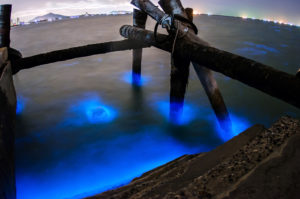
Bioluminescence
Bioluminescence is one of the ocean’s most magical night dive experiences. The phenomenon — the production of light by a living organism — looks like suspended fairy lights underwater. Though it’s possible to see bioluminescence on land, it’s most common underwater thanks to the many vertebrates and invertebrates in the ocean. Many deep-sea creatures use it as a defense or to lure prey, but the simplest way to experience bioluminescence as a diver is via the tiny plankton in the ocean that glow when set in motion. Simply cover you light and wave your hand through the water to create a magic light show.
Sleeping sea creatures
When nocturnal animals awaken on the reef, daylight creatures go to sleep. Lucky night divers might spy a sleeping turtle — do not disturb — and lots of reef fish in a deeply relaxed state. Scientists are still researching the nature of fish sleep, as many animals only rest and maintain awareness of predators. On a reef you’ll see many tucked away in the nooks and crannies of the coral providing them shelter and protection for the night. Parrotfish actually secrete a protective mucus bubble around themselves or across the entrance to their hiding spots in the reef to ward of predators or parasites while they rest. If you’re diving early in the morning, watch for discarded mucus bags, floating in the water like snot.
Special note: As every good diver knows, you should never touch marine life. This is even more important at night, so never touch sleeping animals or shine your torch on one for too long.
Coral
Coral reefs are spectacular during the day, but they’ll wow you at night as well. As light is filtered out, colors become muted the deeper we go. But at night, your light source is much closer — the torch in your hand. In that concentrated light, colors will appear much more vivid than during the day. In addition, colorful coral polyps open up at night to feed on nutrients in the ocean, so pause on your next night dive and give the coral a good look.
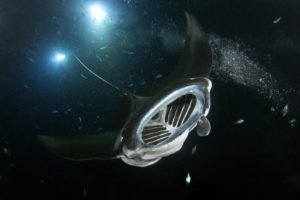
Manta rays
There are several spots around the world where you can do night dives with mantas. Lucky divers will see large feeding aggregations of dozens of mantas, unfolding like a nighttime ballet. These majestic animals swoop and fly, feeding on the plankton and small creatures that are drawn to the light of divers’ torches or the dive-boat lights. La Paz, Mexico; Raja Ampat, Indonesia; and Kona, Hawaii are some of the most famous spots for these encounters.
Enhanced perception
At night everything is different, even our perception. Not only does the darkness alter your sense of what’s around you, but it also enhances things like your perception of sound. Popular sites are usually far quieter at night, with fewer boat engines and less diver activity. Through this quiet, you start to notice natural sounds become amplified, such as the crackling and popping sounds that are far more pronounced than during the day. Various marine creatures produce the sound when they eat algae or coral polyps off the reef, combined with the sound of small shrimp snapping their claws. Keep your ears open during your night dives and you’ll hear a whole new world.
The post Five Great Night Dive Experiences appeared first on Scuba Diver Life.
from Scuba Diver Life https://ift.tt/2pSUyCN
Five Great Night Dive Experiences
Just as on land, where the nocturnal world is quite different from the daytime one, so too does a new environment appear underwater after dark. Even your most regular dive spot becomes mysterious at night. But what makes a night dive so different from a daytime dive? Here are five great night dive experiences you can only have after the sun goes down.
Bioluminescence
Bioluminescence is one of the ocean's most magical night dive experiences. The phenomenon — the production of light by a living organism — looks like suspended fairy lights underwater. Though it's possible to see bioluminescence on land, it's most common underwater thanks to the many vertebrates and invertebrates in the ocean. Many deep-sea creatures use it as a defense or to lure prey, but the simplest way to experience bioluminescence as a diver is via the tiny plankton in the ocean that glow when set in motion. Simply cover you light and wave your hand through the water to create a magic light show.
Sleeping sea creatures
When nocturnal animals awaken on the reef, daylight creatures go to sleep. Lucky night divers might spy a sleeping turtle — do not disturb — and lots of reef fish in a deeply relaxed state. Scientists are still researching the nature of fish sleep, as many animals only rest and maintain awareness of predators. On a reef you'll see many tucked away in the nooks and crannies of the coral providing them shelter and protection for the night. Parrotfish actually secrete a protective mucus bubble around themselves or across the entrance to their hiding spots in the reef to ward of predators or parasites while they rest. If you're diving early in the morning, watch for discarded mucus bags, floating in the water like snot.
Special note: As every good diver knows, you should never touch marine life. This is even more important at night, so never touch sleeping animals or shine your torch on one for too long.
Coral
Coral reefs are spectacular during the day, but they'll wow you at night as well. As light is filtered out, colors become muted the deeper we go. But at night, your light source is much closer — the torch in your hand. In that concentrated light, colors will appear much more vivid than during the day. In addition, colorful coral polyps open up at night to feed on nutrients in the ocean, so pause on your next night dive and give the coral a good look.
Manta rays
There are several spots around the world where you can do night dives with mantas. Lucky divers will see large feeding aggregations of dozens of mantas, unfolding like a nighttime ballet. These majestic animals swoop and fly, feeding on the plankton and small creatures that are drawn to the light of divers' torches or the dive-boat lights. La Paz, Mexico; Raja Ampat, Indonesia; and Kona, Hawaii are some of the most famous spots for these encounters.
Enhanced perception
At night everything is different, even our perception. Not only does the darkness alter your sense of what's around you, but it also enhances things like your perception of sound. Popular sites are usually far quieter at night, with fewer boat engines and less diver activity. Through this quiet, you start to notice natural sounds become amplified, such as the crackling and popping sounds that are far more pronounced than during the day. Various marine creatures produce the sound when they eat algae or coral polyps off the reef, combined with the sound of small shrimp snapping their claws. Keep your ears open during your night dives and you'll hear a whole new world.
The post Five Great Night Dive Experiences appeared first on Scuba Diver Life.
from Scuba Diver Life https://ift.tt/2pSUyCN
Subscribe to:
Posts (Atom)